How Are Lab-Grown Diamonds Made?
Two very different processes, one result. A plain walkthrough of what happens inside each chamber.
Quick Answer
Lab-grown diamonds are made by growing diamond crystals around a small diamond seed in a controlled environment. The two main methods are Chemical Vapor Deposition (CVD) and High Pressure High Temperature (HPHT). CVD grows diamond from carbon-containing gases inside a chamber, while HPHT uses very high pressure and temperature to grow diamond from a seed. Both methods can produce genuine diamonds.
Key Takeaways
- CVD and HPHT are the two main methods used to grow lab-grown diamonds.
- Both methods start with a small diamond seed.
- CVD uses a controlled chamber and carbon-containing gases.
- HPHT uses very high pressure and temperature.
- The resulting crystal is then cut and polished for jewellery.
- The growth method can leave characteristics that gemological laboratories can identify.
It Starts With a Diamond Seed
Lab-grown diamond production begins with a small piece of diamond called a diamond seed.
Think of the seed as the starting point for a much larger crystal. The conditions around it are carefully controlled so that carbon can form into the diamond crystal structure and continue growing.
The two main ways of creating those conditions are CVD and HPHT.
How CVD Diamonds Are Grown
CVD stands for Chemical Vapor Deposition.
A diamond seed is placed inside a chamber. The chamber is filled with a controlled mixture of gases containing carbon, commonly including methane and hydrogen.
Energy is then introduced into the chamber to create a plasma. This breaks down the gas molecules and allows carbon-containing particles to deposit onto the diamond seed.
The diamond grows gradually, layer by layer.
The CVD Process in Simple Terms
```text Diamond seed ↓ Controlled vacuum chamber ↓ Carbon-containing gases ↓ Plasma ↓ Carbon deposits on seed ↓ Diamond crystal grows ```
The process is carefully monitored because conditions such as temperature, pressure, gas composition, and growth rate affect the resulting crystal.
How HPHT Diamonds Are Grown
HPHT stands for High Pressure High Temperature.
This method uses a diamond seed together with a carbon source. The materials are placed in a growth cell and exposed to extremely high pressure and temperature.
Under these conditions, the carbon dissolves and then crystallises around the diamond seed.
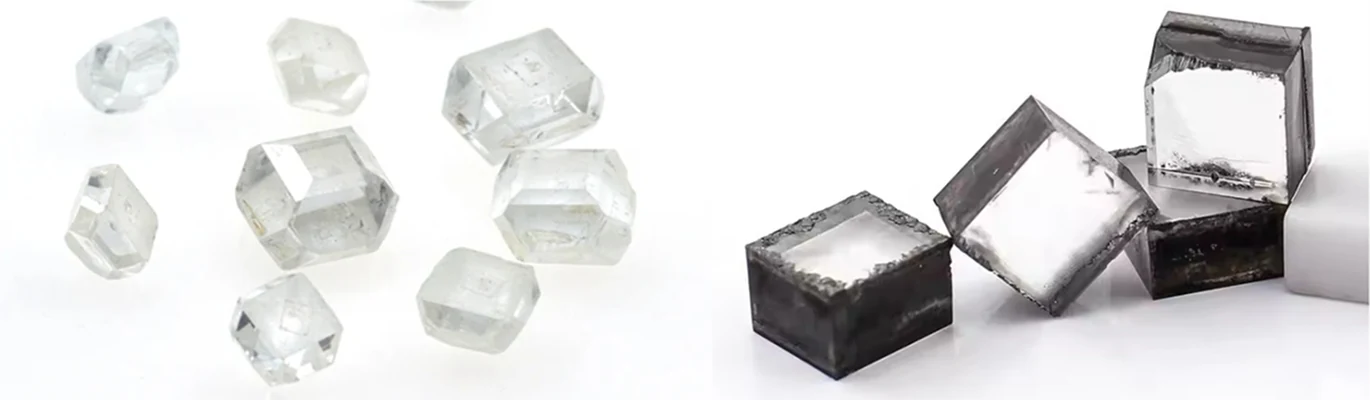
The result is a larger diamond crystal that can later be cut and polished.
The HPHT Process in Simple Terms
```text Diamond seed + carbon source ↓ High pressure + High temperature ↓ Crystal growth ↓ Diamond crystal ```
CVD vs HPHT
The two methods are different, but neither should be treated as a simple quality ranking.
| CVD | HPHT | |
|---|---|---|
| Full name | Chemical Vapor Deposition | High Pressure High Temperature |
| Basic approach | Grows diamond from carbon-containing gases | Uses high pressure and high temperature |
| Starting point | Diamond seed | Diamond seed and carbon source |
| Environment | Controlled chamber | High-pressure growth cell |
| Can produce gem-quality diamond? | Yes | Yes |
The quality of a finished diamond depends on more than its growth method. Cut, colour, clarity, proportions, polish, and other characteristics all matter.
What Happens After the Diamond Is Grown?
Growing the crystal is only the beginning.
A rough lab-grown diamond still needs to be:
- Examined
- Cut
- Shaped
- Polished
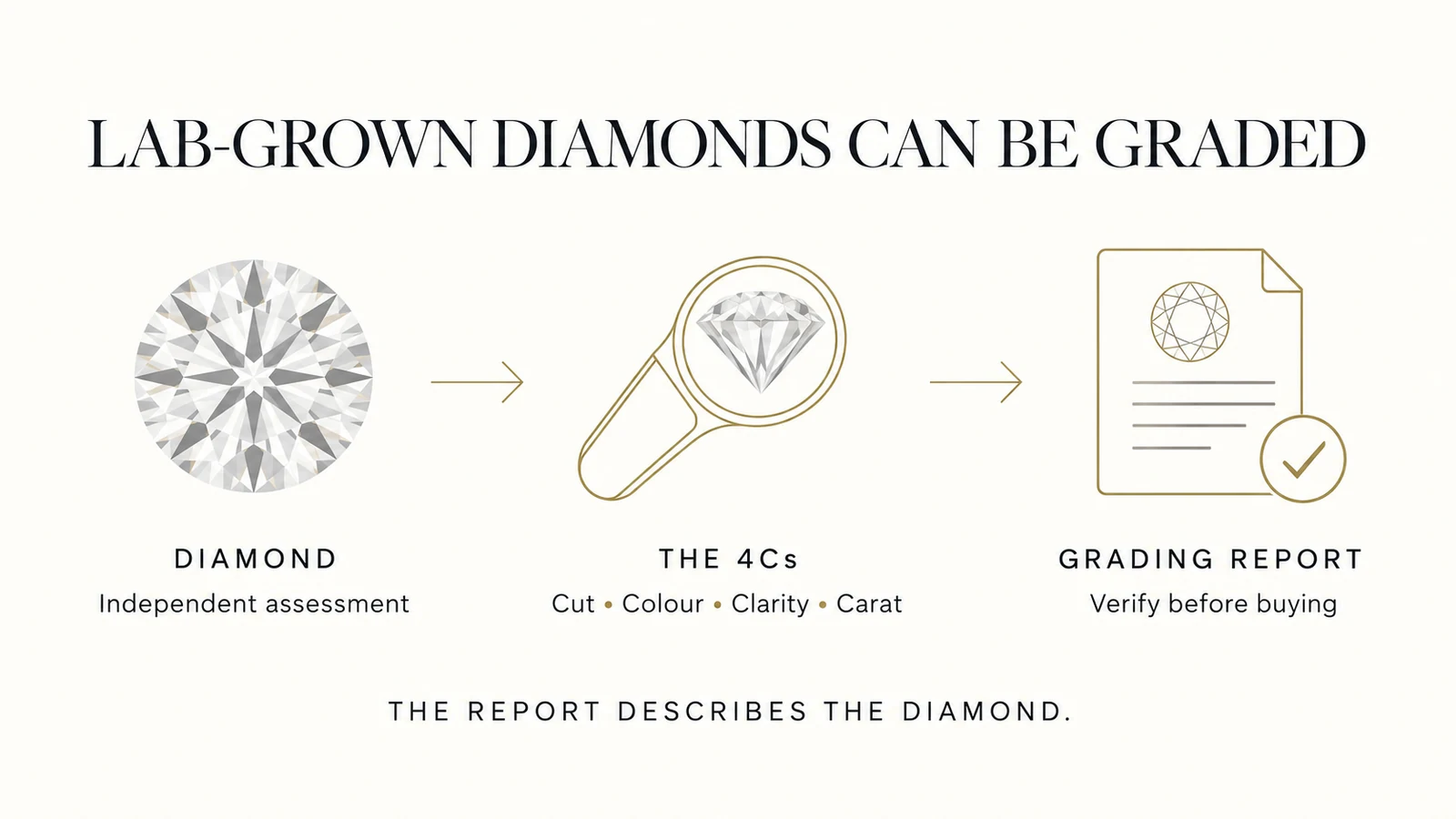
- Graded where applicable
- Set into jewellery
The rough crystal may be cut into a round brilliant, oval, cushion, emerald, radiant, pear, or another shape.
This is where the skill of diamond cutting becomes important. The final appearance of the stone depends heavily on how the rough crystal is planned and cut.
Can Lab-Grown Diamonds Be Treated?
Some laboratory-grown diamonds can undergo treatments after growth.
Treatments can be used to modify or improve certain characteristics. Depending on the stone and laboratory, relevant treatment information may be recorded on a grading report.
This is one reason it is useful to look at the documentation for an individual diamond rather than making assumptions about every lab-grown diamond.
Can You Tell How a Lab-Grown Diamond Was Grown?
Sometimes.
Gemological laboratories can use specialised testing to identify characteristics associated with different growth methods and treatments.
A grading report may include information about the growth method or treatment where relevant.
For a buyer, the simplest approach is to check the report and ask the jeweller if you want more information about a particular stone.
How Long Does It Take to Grow a Lab-Grown Diamond?
There is no single number that applies to every diamond.
Growth time depends on the method, equipment, size and quality being produced, and the conditions used during the process.
The growth itself often takes weeks, although the exact time varies with the method, size and desired quality. Cutting, polishing and grading come afterwards.
So a finished lab-grown diamond is not simply produced and ready for jewellery immediately after the crystal has grown.
Aureva’s Perspective
Knowing how a diamond was grown matters less than knowing what you are buying, but it is not nothing. Aureva works in CVD-grown diamonds, and it is what we would recommend if you are choosing between the two processes. That is a preference built on the material we source and inspect rather than a claim that the other process cannot produce a fine stone. Whichever you choose, ask for the report and read the grades on it.
Frequently Asked Questions
What are the two methods used to make lab-grown diamonds?
The two main methods are CVD and HPHT.
Which is better, CVD or HPHT?
Neither method guarantees a better stone on its own — quality comes down to the individual diamond and its cut, colour, clarity and proportions. As a preference, Aureva works in CVD and that is the route we would recommend.
Are CVD diamonds real diamonds?
Yes. CVD can be used to grow genuine diamond crystals.
Are HPHT diamonds real diamonds?
Yes. HPHT can also be used to grow genuine diamond crystals.
How long does it take to grow a lab-grown diamond?
The time varies. Growth often takes weeks, depending on the equipment, process, crystal size and desired quality.
Sources
About the Author
The Aureva Editorial Team
The Aureva editorial team writes the Journal. We work with lab-grown diamonds and 14KT gold every day, and we write about what we can verify, such as grading reports, growth methods, and what we see across our own orders.