Are Lab-Grown Diamonds Certified?
A report is the one part of a diamond purchase you can check for yourself. Here is what it does and does not tell you.
Quick Answer
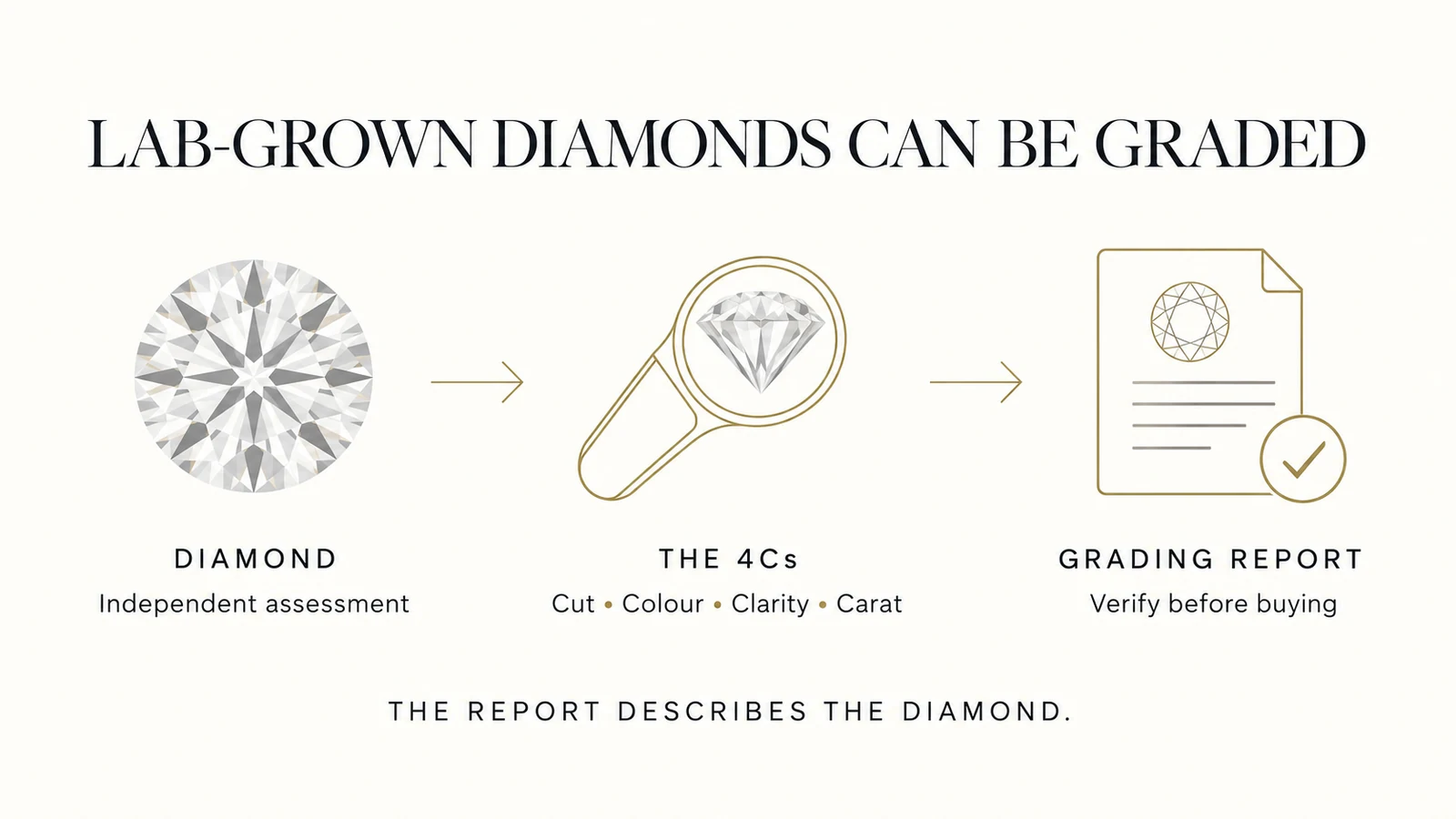
Yes. Lab-grown diamonds can be independently graded and documented by gemological laboratories. In consumer language, this is often described as being "certified," but the more precise term for the document is a grading report. A grading report can provide information about characteristics such as carat weight, colour, clarity, measurements and laboratory-grown origin. Depending on the laboratory and report, it may also include information about the growth method or treatments.
Key Takeaways
- Lab-grown diamonds can receive independent grading reports.
- A report is about a specific diamond, not lab-grown diamonds as a whole.
- Reports can identify laboratory-grown origin.
- The information included depends on the laboratory and report type.
- Buyers should read the report rather than treating "certified" as a guarantee of overall value.
What Does Diamond Certification Mean?
People often use the word "certified" when talking about diamonds.
In practice, what you usually want to look for is a grading report from a recognised gemological laboratory.
A grading report describes the characteristics of a particular diamond.
That distinction matters.
A report does not simply say, "This is a good diamond." It records observations and measurements about that specific stone.
What Can a Lab-Grown Diamond Report Tell You?
Depending on the laboratory and report, you may see information such as:
- Carat weight
- Colour grade
- Clarity grade
- Measurements
- Cut information where applicable
- Polish
- Symmetry
- Laboratory-grown origin
- Growth method
- Treatment information where applicable
The exact contents vary by report.
This is why it is worth looking at the actual document rather than assuming every report contains exactly the same information.
Who Grades Lab-Grown Diamonds?
Several established gemological laboratories provide services for laboratory-grown diamonds.
IGI is one example and offers reports specifically for laboratory-grown diamonds.
Other laboratories also provide diamond grading services, with their own report formats and standards.
If you are buying a particular diamond, ask which laboratory issued its report and check the report number and details.
Is a Lab-Grown Diamond Without a Report Fake?
No.
A lab-grown diamond does not become a diamond only because it has a grading report.
The report is documentation about the individual stone.
However, independent documentation can be useful because it gives the buyer a clearer record of the diamond's characteristics and origin.
Whether a report is important to you may depend on the size and value of the stone, the seller, and your own comfort as a buyer.
How Do You Read a Lab-Grown Diamond Report?
Start with the basics.
1. Check the Report Number
Make sure the report corresponds to the diamond being offered.
2. Check the Origin
The report should clearly identify the stone as laboratory-grown if that is its origin.
3. Look at the 4Cs
Check the listed:
- Carat
- Colour
- Clarity
- Cut
Not every report format grades every characteristic in exactly the same way, so read the document carefully.
4. Look at Additional Details
Measurements, polish, symmetry, fluorescence, growth method, treatments and other information may be listed depending on the report.
Does Certification Guarantee a Good Diamond?
No.
A grading report gives you information. It does not replace your own evaluation of the finished diamond.
Two diamonds with the same broad grades can still look different.
Cut quality, proportions and the actual appearance of the stone matter.
This is particularly important when choosing a diamond for jewellery that you will see and wear every day.
Can Lab-Grown Diamonds Have an IGI Report?
Yes.
IGI provides grading reports for laboratory-grown diamonds.
An IGI report can identify the diamond as laboratory-grown and provide relevant grading information.
For a specific stone, use the report details and report number rather than relying only on a seller's summary.
Aureva’s Perspective
We think a grading report should make buying a diamond less confusing, not more. You do not need to memorise every term on the report. Start with the basics. Understand the stone's origin, its 4Cs, its measurements and any relevant treatment information. If something is unclear, ask. A good jewellery buying experience should leave you knowing what you bought.
Frequently Asked Questions
Are lab-grown diamonds certified?
They can be independently graded and documented by gemological laboratories.
What is the best certification for a lab-grown diamond?
There is no need to reduce the decision to a single word such as "best." Look at the reputation of the laboratory, the report type, the information provided, and the individual diamond.
Does every lab-grown diamond have a certificate?
No. Not every stone necessarily comes with an independent grading report. Ask the seller what documentation is available.
Can I verify a lab-grown diamond report?
Many laboratories provide online report verification. Use the issuing laboratory's official verification service and compare the details with the stone and report you have been given.
Does a certificate increase the value of a lab-grown diamond?
A report provides documentation and can make it easier to assess a stone. It should not be treated as a guarantee of market value or resale value.
Sources
About the Author
The Aureva Editorial Team
The Aureva editorial team writes the Journal. We work with lab-grown diamonds and 14KT gold every day, and we write about what we can verify, such as grading reports, growth methods, and what we see across our own orders.