Cushion vs Oval Lab-Grown Diamonds: Which Should You Choose?
Both are softer alternatives to round, but they create very different silhouettes and patterns of light.
Quick Answer
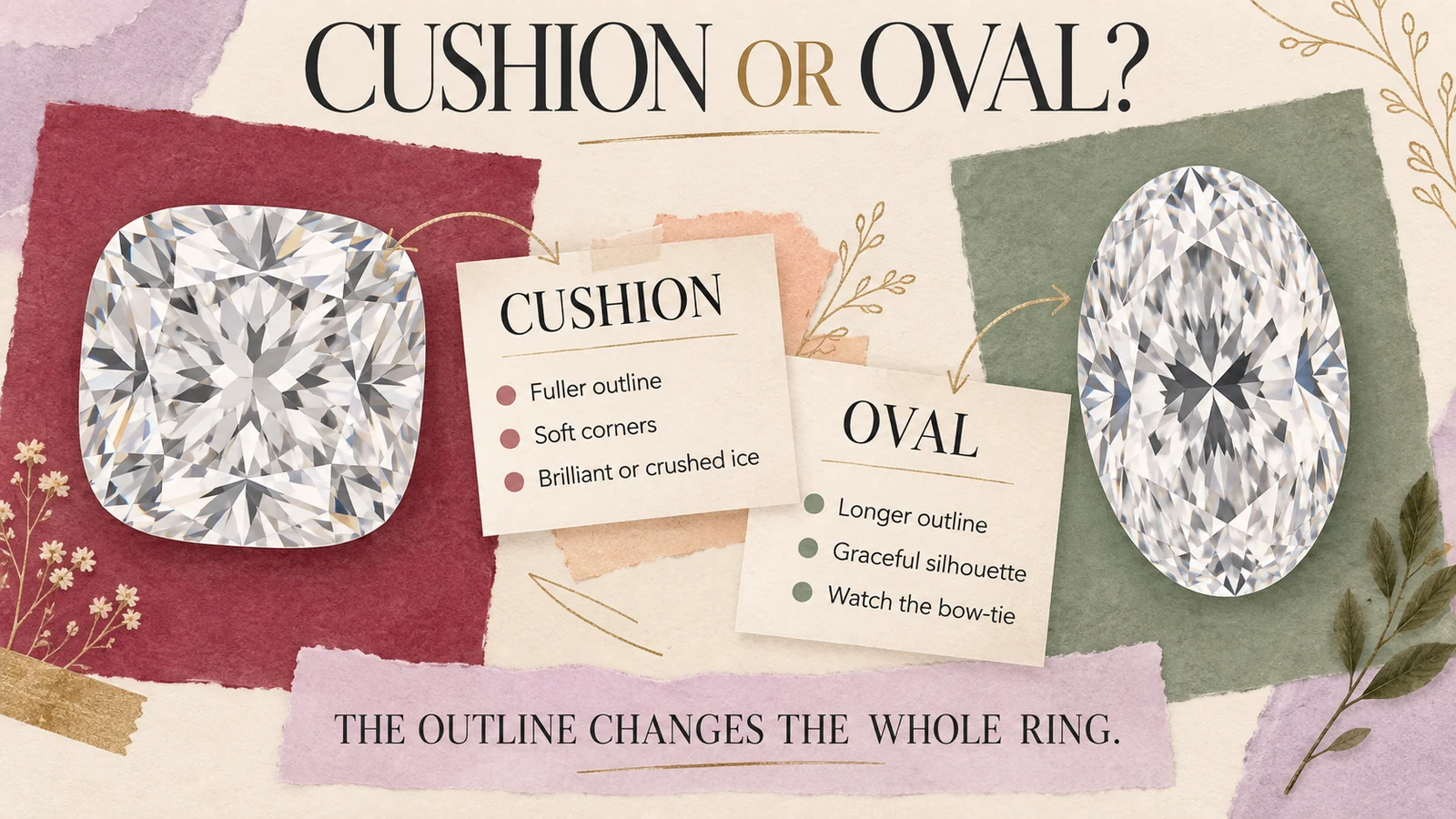
Oval and cushion lab-grown diamonds both have softer outlines, but they look quite different. Oval is elongated and usually brilliant cut. Cushion has rounded corners and can be square or rectangular, with brilliant or modified brilliant faceting. Some modified cushions show the fragmented "crushed ice" look. Choose oval for a longer, more elongated silhouette. Choose cushion if you prefer a fuller outline and softer corners.
Key Takeaways
- Oval stretches the design vertically, while cushion feels wider and softer.
- Cushion diamonds can have brilliant or modified brilliant faceting.
- Modified cushions can show a "crushed ice" appearance.
- Ovals can have a bow-tie pattern, so the centre of the stone deserves attention.
- Both shapes can show colour differently depending on their proportions and faceting.
Start With the Outline
If you put an oval and a cushion side by side, the difference is obvious.
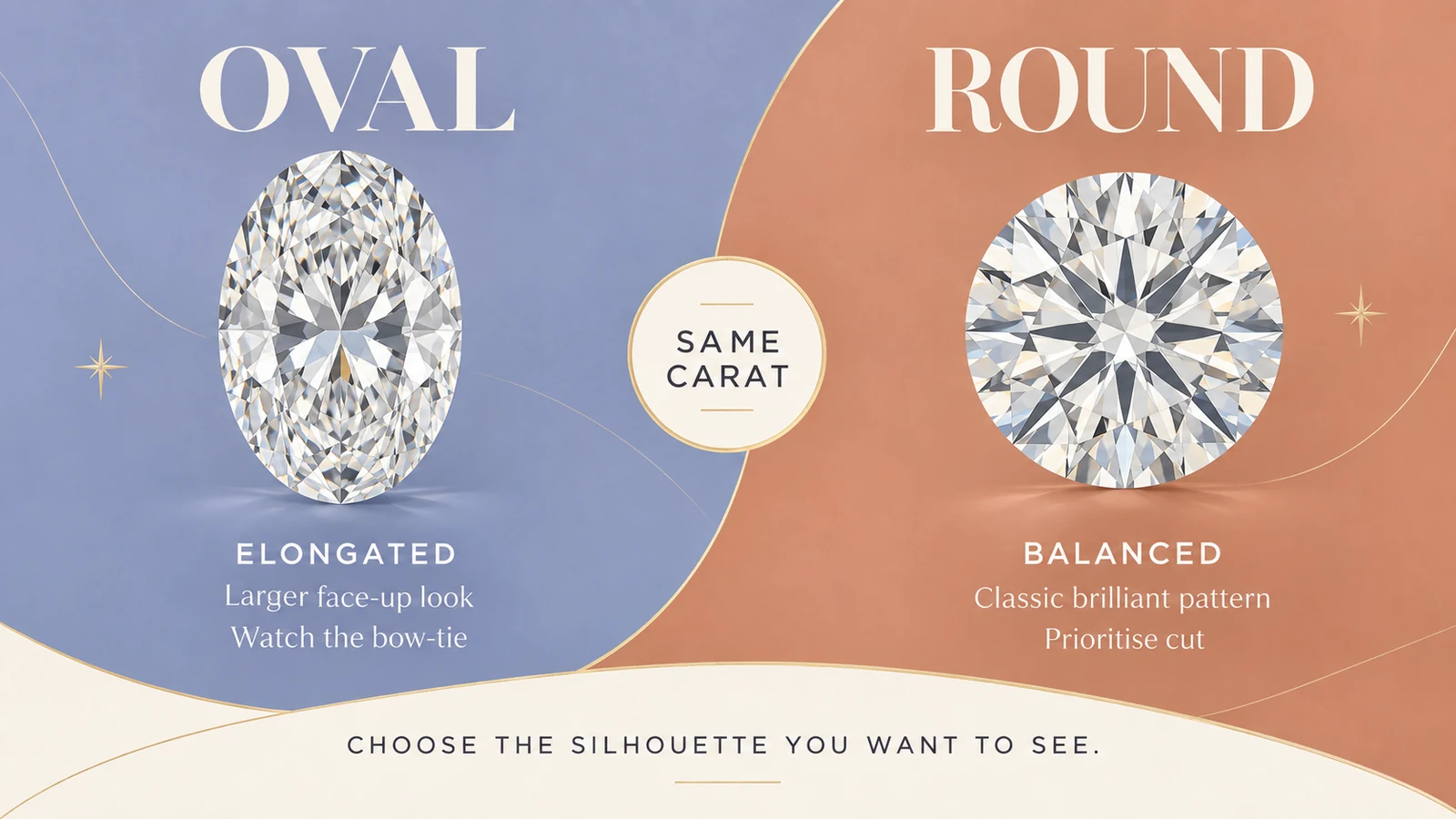
Oval is long and narrow to varying degrees.
Cushion is usually square or rectangular with rounded corners.
That changes how the ring sits on the hand.
An oval tends to create a longer visual line. A cushion feels more compact and substantial.
Cushion vs Oval at a Glance
| Oval | Cushion | |
|---|---|---|
| Outline | Elongated | Square or rectangular with rounded corners |
| General feel | Graceful and elongated | Soft and substantial |
| Faceting | Usually brilliant-style | Brilliant or modified brilliant |
| Common visual pattern | Brilliant flashes, possible bow-tie | Soft sparkle or crushed ice |
| Face-up presence | Often strong for its weight | Can appear deeper |
| Main watch-out | Bow-tie and outline | Faceting style and depth |
Cushion Has More Than One Look
"Cushion" is not one single facet pattern.
GIA distinguishes brilliant cushions from modified cushions. Brilliant cushions have larger facets and a softer sparkle, while modified cushions have extra facets that can create a crushed-ice appearance.
That means two cushions can look surprisingly different even when both have the same shape name.
If you like cushion, ask what kind of faceting you are looking at.
What Does Crushed Ice Mean?
Crushed ice describes a fragmented pattern of smaller light and dark reflections.
Some people love it because it creates a lively, glittering appearance.
Others prefer larger, clearer flashes.
There is no correct preference.
The important part is knowing that a cushion labelled simply "cushion" can have different visual characters.
Oval Has Its Own Variation
Ovals can vary in length-to-width ratio and facet arrangement.
Some look broad and rounded.
Others are long and slender.
Some show a noticeable bow-tie across the centre.
GIA research shows that fancy shapes can have a wide range of visual patterns and that preferences can vary between people.
So with both shapes, the individual diamond matters.
Which Shows Colour More?
There is no simple rule that every cushion shows more colour than every oval.
Faceting, proportions and the diamond's actual colour grade all matter.
Whichever you choose, compare the stones in the metal you intend to use — and on a lab-grown diamond, staying in the colourless EF range removes the question before it arises.
That is especially useful because the setting changes the surrounding colour.
Which Looks Bigger?
Ovals often have a strong face-up presence because of their elongated surface area.
Cushions can carry more depth and may appear slightly smaller face-up for the same weight. GIA notes that cushions can have deeper proportions that affect apparent size.
Again, compare measurements rather than relying on the shape name.
Which Feels More Vintage?
Cushion often works naturally with vintage-inspired jewellery because of its rounded corners and softer outline.
Oval can also look vintage, especially in a halo or detailed setting.
The setting can completely change the character of either shape.
Which Has More Sparkle?
This depends on the actual diamond.
A brilliant cushion can have larger, softer flashes.
A modified cushion may have more fragmented sparkle.
An oval can have strong brilliant-style light performance, but the bow-tie and facet pattern can change the look.
How We Would Choose
Choose oval if the elongated silhouette is what first catches your eye.
Choose cushion if you like a fuller outline and softer corners.
Then compare the actual stones. With cushions especially, do not choose from the word "cushion" alone.
Aureva’s Perspective
Choose oval if the elongated silhouette is what first catches your eye. Choose cushion if you like a fuller outline and softer corners. Then compare the actual stones. With cushions especially, do not choose from the word "cushion" alone.
Frequently Asked Questions
Is oval bigger than cushion for the same carat weight?
Oval can have a stronger face-up appearance because of its elongated outline, but actual measurements and depth determine the result.
What is crushed ice in a cushion diamond?
It describes a fragmented pattern of many small light and dark reflections, often associated with modified brilliant cushions.
Which sparkles more, cushion or oval?
Neither automatically. The individual faceting and proportions matter.
Does cushion show more colour than oval?
It can, depending on the diamond's proportions and faceting. Compare actual stones rather than applying a blanket rule.
Which is better for an engagement ring?
Choose oval for an elongated silhouette or cushion for a softer, fuller outline. Both can work beautifully.
About the Author
The Aureva Editorial Team
The Aureva editorial team writes the Journal. We work with lab-grown diamonds and 14KT gold every day, and we write about what we can verify, such as grading reports, growth methods, and what we see across our own orders.